Volatility and the NOACK Test
"Why do I have to keep adding oil to my engine?"
Volatization, the methods used to test it and why AMSOIL decided customers would care.
When speaking about their vehicles, motorists may comment that their auto "uses a little oil now and then." Although many are positive that the vehicle is "using" this oil, upon further questioning they often cannot explain how or why or where exactly the oil disappeared. Is it leaking? Certainly some vehicles leak an amount of oil out of seals, gaskets and joints. But others that "use" oil have no leaks at all. So where does this oil go? The oil goes through a process known as volatization, and it can end up costing motorists more than just the price of a few quarts of oil.
 Why Oil Volatizes
After crude oil has been pumped from the ground, it is sent to a refinery where it is distilled into its usable
components. Distillation separates the crude into fractions based on their individual boiling ranges. The crude is
heated until each fraction boils off as a vapor, and then is condensed and subjected to further processing. This
boiling is essentially the same circumstance occurring during volatization in an engine, with lighter molecules
vaporizing and heavier molecules remaining. In refining, this process can effectively increase the amount of similar
molecular structures in each fraction, and therefore improve the stability and quality of each product refined.
However, even the final petroleum-based product still consists of a wide range of hydrocarbon structures. These
are sometimes referred to as a "chemical soup."
This "chemical soup" found in standard petroleum mineral oils contributes to many of their shortcomings when
compared with synthetic oils. Because these molecules prevent uniformity, the oil has a tendency to deteriorate
more rapidly. If lighter fractions are present in the oil, they can boil off (or volatize) which leads to oil
consumption, oil thickening and a loss of performance.
 Money to Burn?
Even though many motorists do not realize it, when they notice that their vehicle is "using" oil they are
often witnessing the effects of volatization.
Most simply buy extra oil to replace what they assume the motor has "used" and check regularly to see if the
level is low. But is adding more mineral oil necessarily the best solution to the problem? What they may in fact
be doing by adding more petroleum-based mineral oil is burning up their money.
For example, if an automobile needs five quarts of mineral oil sold at $2 a quart to operate during a 3,000- mile
drain interval, and the mineral oil used in the vehicle volatizes and is replaced at a rate of one quart every
1,000 miles, the automobile actually goes through 7 quarts of mineral oil during the drain interval and the
motorist spends an extra $4 per oil change interval on "topping off" the levels. Considering that the average
vehicle puts on 15,000 miles a year, $20 in extra oil is used to keep the oil levels sufficient.
But extra oil is not the only expense motorists face when dealing with volatization. As motor oil goes through
the process of volatizing, the chemically lighter (or more volatile) portions are always the first to "boil off"
in the oil. This leaves the heavier, less pumpable portions behind. This heavier oil cannot be relied upon to
flow easily and quickly to all of the engine components. The end result is decreased fuel efficiency, premature
component wear and deposit formation within the engine. The expense to the motorist can be quite substantial.
The Synthetic Solution
Synthetic motor oils have a natural advantage over petroleum-based oils when it comes to volatility. This is
because synthetic oils are designed to have uniform chemical structures. This eliminates the extra chemicals and
hydrocarbon structures (or "chemical soup") found in oils based only in mineral stock. Because they contain less
lighter chemical portions to boil off, synthetic products lose less of their lubricating abilities to
volatization.
AMSOIL Synthetic Motor Oils maintain their viscosity and provide ongoing cold start protection, fuel efficiency
and reduced oil consumption.
An AMSOIL First
Surprisingly, volatility was not always considered when comparing motor oils. Few oil companies published test
results measuring an oil's volatility until the 1980s, when AMSOIL became the first in the United States to
publish NOACK Volatility Test results.
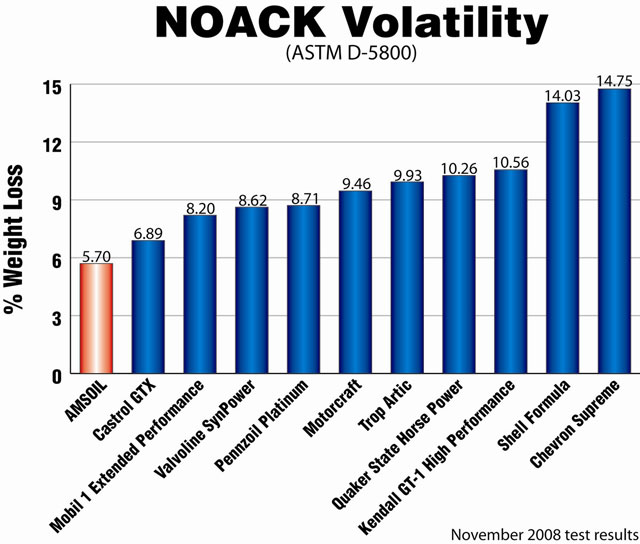
 In the NOACK Volatility Test the oil is heated to 150°C for a specified period. Lighter oil fractions will
"boil off," leading to oil consumption, oil thickening and a loss of performance. The percentage lost, by weight,
due to this "boil-off" is reported.
In the NOACK Volatility Test the oil is heated to 150°C for a specified period. Lighter oil fractions will
"boil off," leading to oil consumption, oil thickening and a loss of performance. The percentage lost, by weight,
due to this "boil-off" is reported.
The test has different passing requirements depending on the weight of the oil being tested. For example, 10W-30
oil in the United States may lose up to 22 percent, by weight, and still be "passable." However, with 20 percent
gone, the oil suffers significant performance deficits in characteristics such as pumpability and
lubricity.
 Effective July 1, 2001, a new specification, known as GF-3, allowed a maximum of 15 percent loss. European
standards, which have been stricter for years, already limited high quality oils to a maximum of 13 percent loss.
AMSOIL 10W-30 loses only 6.76 percent to volatility.
Effective July 1, 2001, a new specification, known as GF-3, allowed a maximum of 15 percent loss. European
standards, which have been stricter for years, already limited high quality oils to a maximum of 13 percent loss.
AMSOIL 10W-30 loses only 6.76 percent to volatility.
AMSOIL reports these results because they enable informed consumers to understand the value offered by synthetic
motor oils. Low oil volatility means reduced oil consumption rates, maximum fuel efficiency and higher levels of
performance for longer periods of time.
We're now on Facebook!

Buy at wholesale price!
Preferred Customers buy at dealer cost and save 25%!
Not sure which products to get for your vehicle? Use the Vehicle Lookup Guide.

AMSOIL Distributor Opportunities
Start your own home business based on a proven superior product. Very low startup costs.

Sell AMSOIL products in your shop or store. Click here for information on AMSOIL retail accounts.

Does your business purchase lubricants for its equipment? Click for information about AMSOIL commercial accounts! Extend your equipment's life and reduce costs!