The Thick and Thin of Viscosity
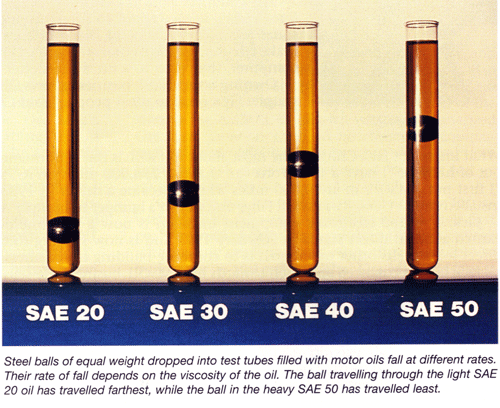 Of all the characteristics a lubricant may possess, the most important is its viscosity. The viscosity of a fluid
and how that fluid reacts to certain variables will determine how well the fluid can perform the basic functions
of a lubricant. What is viscosity? When a fluid is subjected to external forces, it resists flow due to internal
molecular friction. Viscosity is a measure of that internal friction. Viscosity can be referred to as the
measurement of fluid's resistance to flow.
Of all the characteristics a lubricant may possess, the most important is its viscosity. The viscosity of a fluid
and how that fluid reacts to certain variables will determine how well the fluid can perform the basic functions
of a lubricant. What is viscosity? When a fluid is subjected to external forces, it resists flow due to internal
molecular friction. Viscosity is a measure of that internal friction. Viscosity can be referred to as the
measurement of fluid's resistance to flow.
Viscosity can be viewed in two different ways. The first is a fluid's tendency to flow as is visually indicated. One can think of this as the time it takes to watch a fluid pour out of a container. The term used to described this is "Kinematic Viscosity" and it is expressed in units indicating flow volume over a period of time. The most commonly used unit of Kinematic Viscosity is the centistoke (cSt).
A fluid's viscosity can also be indicated by measured resistance. You can think of this as the energy required to move an object through the fluid. It takes little energy to stir water with a spoon. However, significantly more energy is required to stir honey with that same spoon. The term used to describe this is "Apparent Viscosity" and it is expressed in units knows as centipoise (cP). There are other ways to refer to a fluid's viscosity. Some of the more common generic terms are thin, light and low. These terms suggest the fluid flows readily. Water would be an example of such a fluid. Terms such as thick, heavy and high suggest the fluid demonstrates a strong resistance to flow. An example of such a liquid would be honey.
 Viscosity is very important because it is directly related to a fluid's load-carrying ability. The great a
fluid's viscosity, the greater the loads that it can withstand. The viscosity of a fluid must be adequate to
separate moving parts at the operating temperature of the equipment. Knowing that a fluid's viscosity is directly
related to its ability to carry a load, one would think that the more viscous a fluid is, the better it can
lubricate and protect. The fact is, the use of high viscosity fluid can be just as detrimental as using too light
an oil. If you use too low of a viscosity oil, you get metal-to-metal contact, poor sealing and increased oil
consumption. If you use too high of a viscosity oil, you get increased fluid friction, reduced energy efficiency,
high operating temperatures, and hard starting - particularly at cold temperatures. The key is to select a fluid
that is not too light and also not too heavy.
Viscosity is very important because it is directly related to a fluid's load-carrying ability. The great a
fluid's viscosity, the greater the loads that it can withstand. The viscosity of a fluid must be adequate to
separate moving parts at the operating temperature of the equipment. Knowing that a fluid's viscosity is directly
related to its ability to carry a load, one would think that the more viscous a fluid is, the better it can
lubricate and protect. The fact is, the use of high viscosity fluid can be just as detrimental as using too light
an oil. If you use too low of a viscosity oil, you get metal-to-metal contact, poor sealing and increased oil
consumption. If you use too high of a viscosity oil, you get increased fluid friction, reduced energy efficiency,
high operating temperatures, and hard starting - particularly at cold temperatures. The key is to select a fluid
that is not too light and also not too heavy.
Fluids thicken as their temperatures decrease and thin as their temperatures increase (like candle wax). The extent that they change is indicated by their viscosity index (VI). A viscosity index number indicates the degree of change in viscosity of an oil within a given temperature range, currently 40-100°C. An oil with a high viscosity index, say 160, would look and behave similarly at these two temperatures. However, a low viscosity index oil, say 90, would be quite different. It would become very fluid, and thin and pour easily at high temperatures. Honey will do the same if you heat it up on a stove. This is why multi-grade oils exist.
Multi-grade oils are concerned with performance at both high and low temperatures and are designed for use when operating temperatures vary widely. Somebody driving from Fargo to Dallas in January would want a multi-grade oil in his crankcase because it allows for equipment operation in changing climates without the need for changing the oil. A straight SAE 5W oil is suitable for low temperature applications, but thins readily as the temperature increases. On the other hand, a straight SAE 30 is suitable for high temperature applications, but thickens when the temperature decreases. A 5W-30 would thicken and thin less in temperature extremes and would thus be more suitable to the average motorist because it remains in a useable viscosity range for a greater ambient temperature range.
We're now on Facebook!

Buy at wholesale price!
Preferred Customers buy at dealer cost and save 25%!

Not sure which products to get for your vehicle? Use the Vehicle Lookup Guide.

AMSOIL Distributor Opportunities
Start your own home business based on a proven superior product. Very low startup costs.

Sell AMSOIL products in your shop or store. Click here for information on AMSOIL retail accounts.

Does your business purchase lubricants for its equipment? Click for information about AMSOIL commercial accounts! Extend your equipment's life and reduce costs!